TikTok Engagement Rate Calculator (Free, 2026)
Three formulas, per-tier and per-niche benchmarks. Pick the math that matches your reporting and see where you stand.
Most accurate for TikTok. Views are inflated relative to followers because of the For You page.
TikTok benchmarks by follower tier
Approximate ranges from public industry studies. Values shift with the formula you use - switch the toggle above to update the table.
| Tier | Followers | Engagement Rate |
|---|---|---|
| Nano | < 10K | 9% - 15% |
| Micro | 10K - 50K | 7% - 12% |
| Mid-tier | 50K - 500K | 5% - 10% |
| Macro | 500K - 1M | 4% - 8% |
| Mega | 1M+ | 3% - 7% |
Ranges are approximate and based on aggregated public studies (Statista, Influencer Marketing Hub, Rival IQ). Your niche and content format will shift the band.
Per-niche benchmarks
Rough ranges per niche, calculated by views (the most common TikTok formula).
Beauty & Skincare
6 - 11%Strong saves/shares on tutorials and product reveals.
Food & Cooking
7 - 13%Recipes are highly shareable; saves dominate.
Finance & Business
4 - 8%Lower likes, higher shares; audience values utility over reaction.
Education & How-To
6 - 12%Completion rate is the real signal here, not raw likes.
Lifestyle & Travel
5 - 10%Aspirational content drives saves more than comments.
Comedy & Entertainment
8 - 16%Highest raw ER but lowest conversion intent.
Why a single engagement rate lies
Engagement rate is a single number trying to summarize three or four very different behaviors. On TikTok specifically, it misses what actually moves the algorithm: completion rate (did viewers watch to the end?), watch time (how many seconds did they spend?), and re-watches (did they loop).
A video with 40% completion rate and 8% ER will out-perform a video with 90% completion and 12% ER over time, because TikTok's recommender prioritizes attention time. A high ER on a 6-second video is often just a hook landing, not a quality signal.
Treat ER as one of four numbers you track per post: ER, completion rate, average watch time, and shares-to-views ratio. Shares matter most for predicting next-video reach - they signal "I want my friend to see this," which the algorithm reads as endorsement.
How to find these numbers in TikTok
- Switch to a TikTok Business or Creator account. Settings → Account → Switch to Business/Creator Account. Free.
- In the app: Profile → three lines (top right) → Creator Tools → Analytics.
- On desktop: visit tiktok.com/analytics - the desktop dashboard exports CSV and shows longer time windows.
- Per-video metrics: tap any video → "Analytics" tab. Shows views, likes, comments, shares, saves, reach, average watch time, retention curve.
- For accurate ER, average your numbers across your last 10-12 videos. A single viral video skews the calculation.
FAQ
Track TikTok engagement automatically
Inflowave pulls TikTok + Instagram + YouTube analytics into one dashboard. Per-video ER, watch time, completion rate, and benchmarks vs your own historical baseline.
What TikTok engagement rate actually measures
TikTok engagement rate is the percentage of viewers who interact with your content beyond just watching it. The standard formula divides total interactions (likes, comments, shares, saves, plays beyond a threshold) by total views, then multiplies by 100. It sounds simple but the practical interpretation requires more nuance than most calculators expose.
The first nuance is that TikTok's algorithm weights different interactions differently. Shares carry the most weight because they expand your reach into the sharer's network. Saves carry the next-highest weight because they signal long-term value. Comments are valuable for distribution but easy to game with bait content. Likes are the lowest-weight signal in 2026, downgraded sharply over the past two years as TikTok detected like-bot patterns.
The second nuance is that engagement rate alone doesn't predict reach. Two videos with identical engagement rates can have vastly different reach if their watch completion rates differ. A 30-second video with 50% completion rate and 5% engagement will outperform a 30-second video with 95% completion rate and 8% engagement, because completion rate trumps engagement rate as a distribution signal in the FYP algorithm.
Industry engagement rate benchmarks for 2026
Engagement rate benchmarks vary significantly by industry and follower count. Generic "average engagement rate is X percent" claims are misleading because they don't account for either dimension. Use these tier-by-niche benchmarks to interpret your number against meaningful comparisons.
| Niche | < 10k followers | 10k-100k | 100k+ |
|---|---|---|---|
| Beauty / fashion | 9-14% | 6-10% | 3-6% |
| Fitness / nutrition | 10-15% | 7-11% | 4-7% |
| Food / cooking | 12-18% | 8-13% | 5-8% |
| B2B / education | 6-10% | 4-8% | 2-5% |
| Comedy / entertainment | 14-22% | 10-16% | 7-11% |
| Finance / investing | 7-11% | 5-8% | 3-6% |
Engagement rate naturally declines with follower count because larger audiences include more passive viewers. This is normal and expected; comparing your engagement rate to a much smaller account in the same niche will always look unfavourable.
Common mistakes that distort your engagement rate
Three measurement mistakes show up repeatedly when accounts evaluate their TikTok engagement. First, averaging engagement across all videos rather than excluding outliers. One viral video can artificially inflate your average for months; one underperforming video can drag it down equally. Use the median, not the mean, when reporting engagement rate over a period.
Second, ignoring video format differences. Long-form videos (over 60 seconds) have structurally different engagement profiles than short-form (under 30 seconds). Mixing them in the same engagement calculation produces a meaningless average. Calculate engagement separately by format.
Third, using engagement rate as a quality proxy without context. Engagement rate is partly a function of audience composition. An account with 50k highly engaged niche followers will outperform an account with 500k mass-audience followers on engagement rate, but the second account may still be more commercially valuable.
How to improve TikTok engagement rate
The highest-leverage moves for improving engagement rate are content-level, not strategy-level. The most reliable improvements come from optimising the opening 1.5 seconds of each video. The hook determines whether the viewer watches at all, and watch completion determines whether the algorithm distributes. A stronger hook lifts both completion rate and total view count, which compounds into higher engagement signals.
The second high-leverage move is shifting calls-to-action from "like and follow" to "save this for later" or "share with someone who needs this". Saves and shares carry more algorithmic weight than likes and follows. Specific CTAs that ask for the higher-weight actions lift engagement rate without changing content quality at all.
The third is posting cadence. Posting more frequently with mediocre content lowers engagement rate because each post competes against the previous for audience attention. Posting less frequently with high-quality content compounds because each post gets full audience attention. Most accounts that suddenly improve engagement rate did so by reducing volume rather than increasing it.
FAQ
Is there a "good" engagement rate I should aim for?
It depends on follower count and niche. Use the benchmark table above. Generally, anything above the median for your niche and follower tier is healthy; anything below should prompt investigation.
Does TikTok show me my engagement rate natively?
No. TikTok shows per-video views, likes, comments, shares, and saves, but doesn't surface engagement rate as a single metric. You have to calculate it yourself or use a tool.
Should I count plays in engagement rate?
No. Plays measure exposure, not engagement. Including them inflates the rate without measuring what engagement is supposed to measure: active participation.
How does TikTok engagement rate compare to Instagram?
TikTok engagement rates are typically 2-3x higher than Instagram for the same content because TikTok's algorithm surfaces content to engaged audiences while Instagram surfaces it to more passive feed scrollers.
Can engagement rate predict revenue?
Not directly. High engagement rate without commercial intent in the audience doesn't convert. Engagement rate is a content quality signal; commercial impact requires audience-product fit on top of it.
Engagement rate in context: what to measure alongside it
Engagement rate is one signal in a portfolio of TikTok metrics. Looking at it in isolation produces misleading conclusions. The metrics that should be tracked alongside it: average watch time, completion rate, share-to-view ratio, follower growth rate, and profile-visit conversion rate.
Each metric tells a different part of the story. Watch time predicts algorithmic distribution. Completion rate predicts FYP placement. Share-to-view ratio predicts viral potential. Follower growth rate predicts long-term audience building. Profile-visit conversion rate predicts whether your content is converting viewers into followers. Engagement rate ties them together but doesn't substitute for any of them.
Building a weekly dashboard that surfaces all these metrics in one view prevents the trap of optimising for engagement rate alone and accidentally hurting one of the other signals.
When low engagement rate is actually fine
Counterintuitively, some accounts with low engagement rates are performing well. Big-budget brand accounts often see engagement rates under 1% because their content reaches massive passive audiences. Educational accounts that drive saves and shares rather than likes can show low engagement on the standard formula while generating outsized commercial impact.
The right question isn't "is my engagement rate higher than the benchmark." The right question is "is my engagement rate trending in the right direction relative to my own historical baseline." Internal trend matters more than external benchmark for understanding whether your content strategy is working.
Track engagement rate by content theme and format. Some themes will consistently outperform others; the long-term move is to shift production toward the themes that perform without abandoning the diversification that keeps your account interesting. The balance between optimization and exploration is what separates accounts that grow steadily from accounts that plateau.
Finally, remember that engagement rate is a signal for the algorithm, not a goal in itself. Optimising every decision around a single number tends to produce homogenized content that hits the metric but loses the audience over time. Use engagement rate as one of several inputs into your content decisions, alongside qualitative judgment about what your audience actually wants to see.
Calculating engagement rate consistently over months teaches you more about your audience than any single benchmark comparison ever will. Make the calculation part of your weekly content review and the insights compound over the quarters that follow.
The teams that grow on TikTok in 2026 share one habit above all others: relentless measurement of the right things. Engagement rate is one of those things when interpreted properly, with the right benchmarks and the right surrounding metrics. Use this calculator as one tool among several, not as a substitute for the broader analytical practice that drives sustained growth.
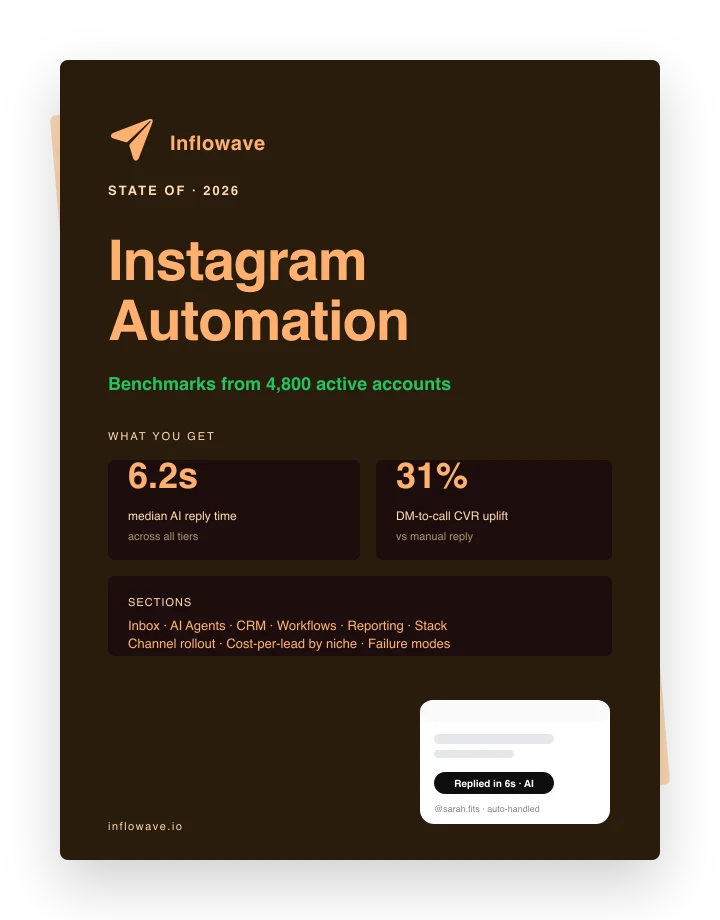
The Automation Benchmarks Are In
Median reply times, DM-to-call CVR uplift, and channel mix from 4,800 active automated accounts. Pulled straight from the platform.